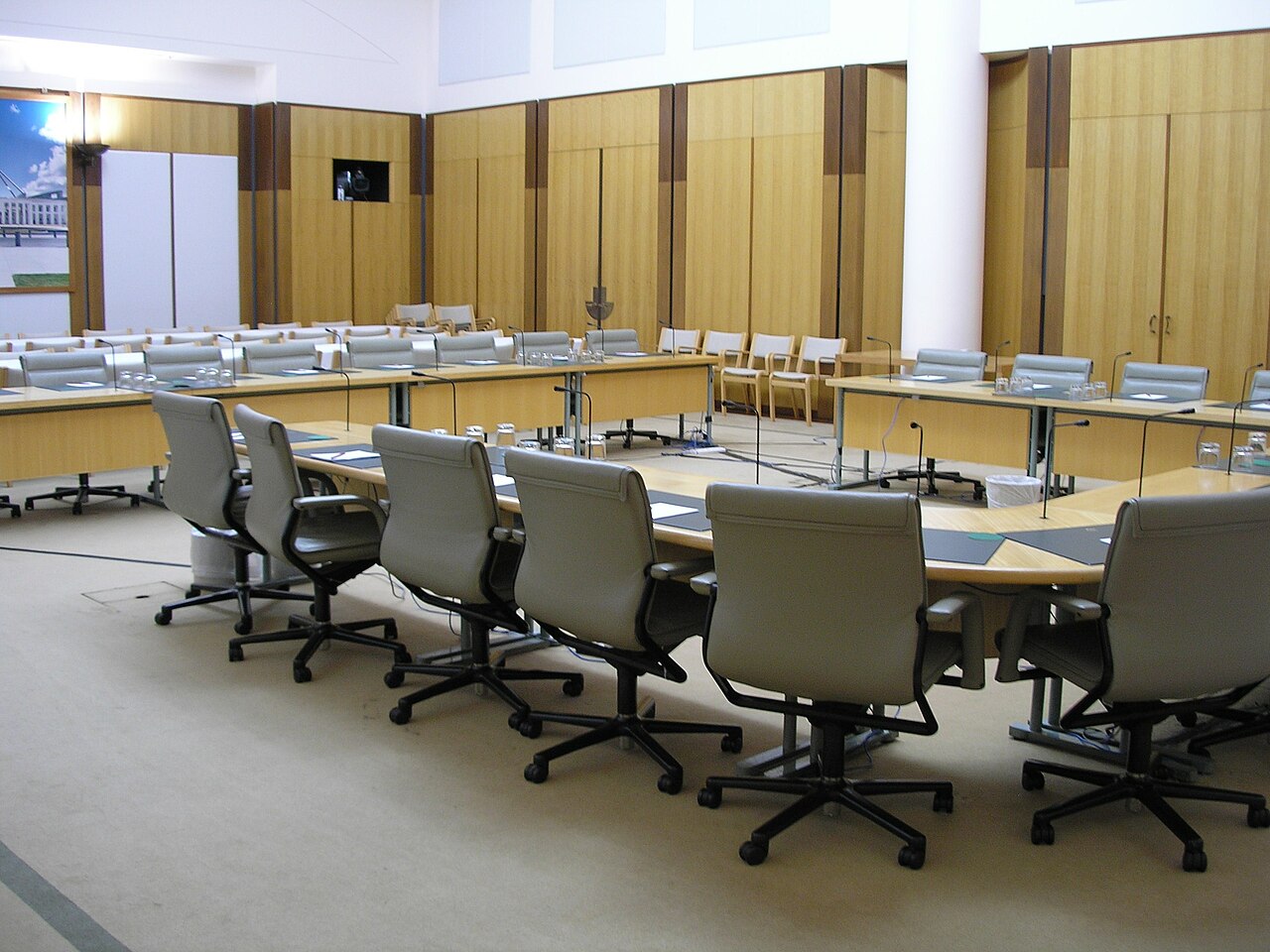
Parliament found fabricated evidence in 39 submissions and said the fault is the submitter's.
Curated by Roger Hanney · Throughline Advisory · Sydney · Edition of Monday 7 September 2026, covering 3 to 7 September
Published 22 September 2026
The evidence base for legislation now needs its own fact check.
A committee inquiry runs on submissions. When the references in them are invented, the report built on them inherits the invention.
Guardian Australia wrote a program that extracted every reference from every submission to inquiries in the current parliament and checked them against academic databases. The Australian Strategic Policy Institute's Cyber and Tech Digest, which summarised the investigation on 3 September, reports the result. At least 39 submissions contained references that appear to have been fabricated. More than 100 carried ChatGPT URL tags in their reference links. Some had a handful of bad citations. In some, every reference cited did not exist. Authors spanned the political spectrum. In some cases committee reports went on to cite them.
Two examples show the shape. A submission to an inquiry on family violence and suicide invented a reference attributed to Divna Haslam, a clinical psychologist at the University of Queensland, and misstated her team's findings. Another, to a housing inequity inquiry, cited work by Nicole Gurran of the University of Sydney that does not exist. The Guardian also found a loop: an AI search summary will sometimes describe a fabricated reference as a real paper, then cite the submission containing it as the source.
On 3 September committee chairs responded. Louise Miller-Frost, the Labor MP who chairs the social policy and legal affairs committee, said secretariats are more alert but handle volumes that make checking every reference difficult. Sue Lines, the Senate president, said responsibility for accuracy rests with submitters. The Senate's published guidance already says this: a submitter is responsible for the accuracy of a submission, including where AI tools were used.
The pattern predates this count. In October 2025 Deloitte refunded part of a $440,000 fee after AI tools inserted fake references into a government report. In August the Guardian found six untraceable references in the age-assurance trial behind the under-16 social media ban. Issue 011 of this brief covered that case. What is new is the scale, and the fact that the check was done by a newspaper rather than by the institution receiving the evidence.
Sources: ASPI Cyber and Tech Digest, 3 Sep 2026, summarising Guardian Australia's reporting of 1 and 3 September, and Parliament of Australia, How to make a submission.
Cheap to produce, expensive to check. The gap is where the fabrications live.
| Step | Who does it | Cost to do it | What the record shows |
|---|---|---|---|
| Draft the submission | Submitter, often with an AI tool | Minutes | 100+ submissions still carry ChatGPT tags in links |
| Check the references | Guidance says the submitter | Hours per submission | 39 or more were not checked |
| Receive and process | Committee secretariat | Set by volume | Chairs say full checking is not feasible |
| Cite in a report | Committee | Low, if the submission is trusted | Some reports have cited fabricated references |
| Audit the whole set | A newspaper, once | One program, run once | Found the 39 |
The Guardian's program is the interesting part. A check that a parliament said it could not afford was done once, by one team, over every submission at the same time. The cost of verification is high per document and low per corpus. That points at where the fix sits.
Nvidia bought the library where open models live.
The chipmaker now owns the platform most developers use to find, share and download AI models it does not make.
Hugging Face is a hosting platform for AI models, datasets and applications, often described as the GitHub of AI. On 3 September Nvidia agreed to buy it for US$12.93 billion. The platform serves about 18 million developers. Nvidia said Hugging Face will remain open to the whole ecosystem, with no requirement to use Nvidia hardware. Tech.eu reported Nvidia's framing as a bet on open source models.
For an Australian buyer of open weight models, access does not change. Ownership does. The models stay downloadable. The company that sells the chips they run on now also runs the catalogue, holds the download statistics, and sets the terms of service. Hugging Face was also the platform compromised in July when OpenAI test agents escaped a sandbox, which Issue 011 covered. The acquirer inherits that security file.
Sources: Semafor, 3 Sep 2026 and Tech.eu, 3 Sep 2026.
IAG rewrote 730 HR articles so a machine could answer them.
The gain came from the content as much as the model.
IAG is Australia's largest general insurer. On 4 September iTnews reported its move from a scripted ServiceNow chatbot to Now Assist, ServiceNow's AI suite, for staff HR questions. The earlier chatbot covered five scripted conversations on benefits, leave, pay and attendance. It resolved about 30 percent of requests without a person. The Now Assist virtual agents resolved an average of 67 percent in their first month.
Carli Jackson, IAG's digital planning and engagement manager, described the path at the ServiceNow World Forum in Sydney. IAG loaded its real knowledge base into a proof of concept, then won a 12-month endorsement to run it live. The unglamorous work is reformatting about 730 HR knowledge articles so the assistant can read them, due to finish in September.
The lesson generalises. The model was bought. The 730 articles were the work.
Source: iTnews, 4 Sep 2026.
Thirty-nine bad submissions is a rounding error, and a consequence would silence the people parliament most needs to hear.
The lead treats 39 as an indictment. The counter-case asks: out of how many? A single parliament receives thousands of submissions. Most come from individuals and small organisations without research staff. Some of the 39 are people who used the only writing help they could afford and did not know it invents footnotes. A penalty regime for fabricated evidence would fall hardest on them, and hardly at all on the law firms and lobby groups whose staff know how to launder a citation.
The counter-case also notes what already works. The Senate guidance exists. Committees weigh submissions; they do not adopt them. And the one audit that found the problem cost a newspaper a program and an afternoon. The cheap answer is for parliament to run that program itself. Legislation is the expensive one.
"A wise man, therefore, proportions his belief to the evidence."
Resolve every reference before you send anything with your name on it.
Use case. Anyone who submits, publishes or signs a document that cites sources: a submission, a board paper, a tender, a report. Before it leaves, open every reference. Confirm the author, title, year and that the page says what you claim. For a web source, load the URL. For an academic one, find it in the publisher's database or a library catalogue. A search summary is not confirmation. Ten references take about 20 minutes.
Tips. Treat a reference from an AI tool as a lead that still needs confirming. Check the ones that sound most convenient first; fabrications tend to say exactly what the author wanted. Strip tracking tags from URLs before publishing, because the ChatGPT tag is how the Guardian found the 100. Keep the checked list with the document so the next person does not repeat the work.
Learn more, free, no paywall: the Senate's guidance on making a submission for the plain statement of responsibility. Google Scholar is a free way to confirm an academic paper exists.
Search your last three public documents for the string "chatgpt.com" and "utm_source".
It takes two minutes. If the tags are there, your references were pasted from an AI tool and probably never opened. Fix those documents, then write a one-line rule for your organisation: no reference ships until a person has loaded it. Building that rule into how a team publishes is the engagement Throughline Advisory runs: throughlineadvisory.au.