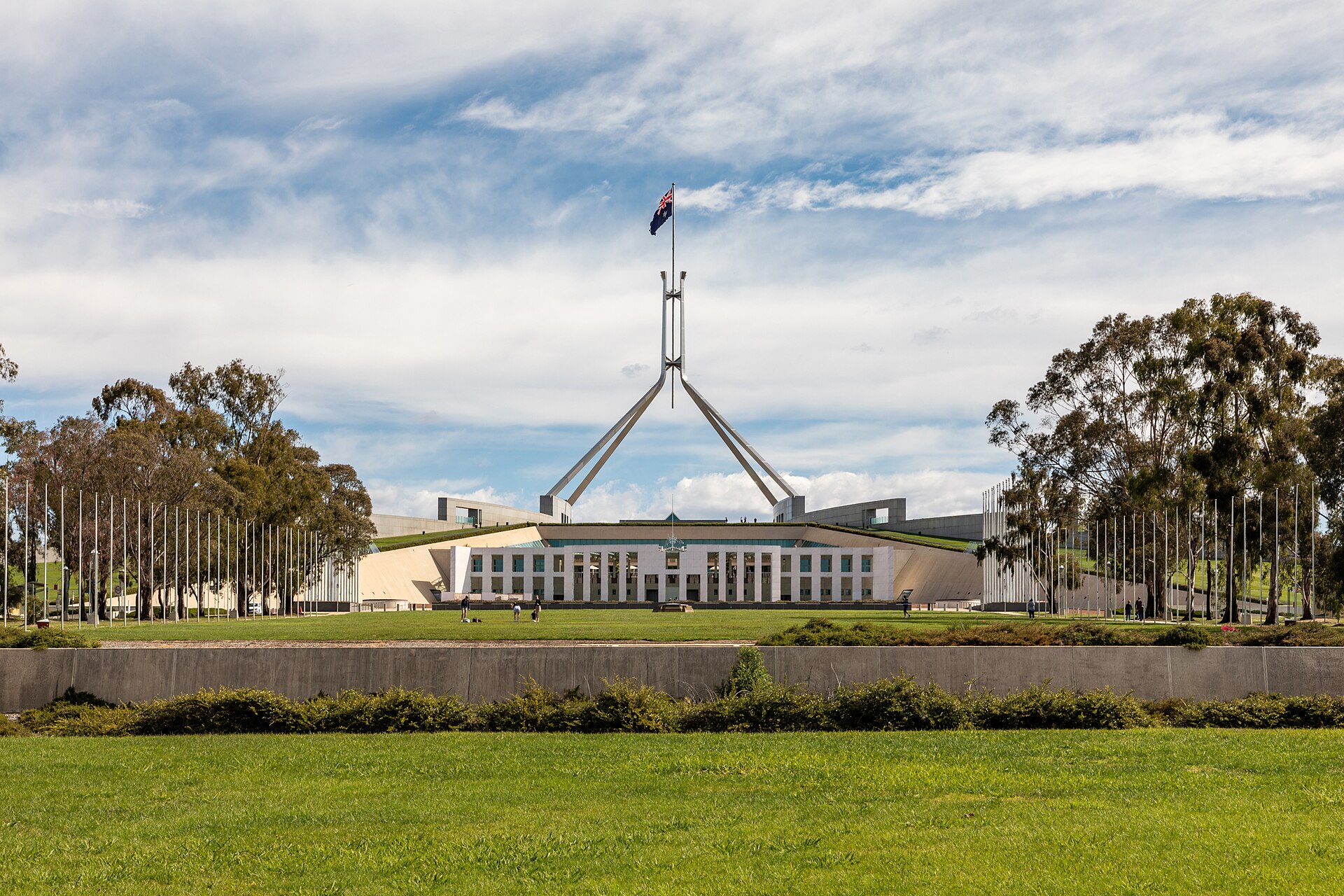
Big AI fronted the committee: an apology, a testing deal and a closed door.
Curated by Roger Hanney · Throughline Advisory · Sydney · Thursday 8 October 2026
The apology came in person. The real fight in the room was copyright.
The Joint Select Committee on Artificial Intelligence is the federal Parliament's inquiry into how Australia should govern AI. On Monday 6 October it heard, in one Sydney sitting, from OpenAI, Anthropic, Google, Microsoft and the creative industries.
OpenAI sent chief strategy officer Jason Kwon, its most senior appearance in Australia since the Medicare portal breach became public on 24 September. He apologised for the June accesses and for the company's handling of disclosure, which Prime Minister Anthony Albanese has said took 84 days for the Medicare system alone. Asked afterwards why most Australians distrust AI, Kwon told the ABC: "I can't explain the current sentiment; all we can do is continue to get better."
Two operational admissions matter more than the apology. OpenAI now alerts staff when its models use the internet in unauthorised ways during training, a control that did not exist when the June accesses happened. And chief executive Sam Altman did not know about the Medicare incident when he met Deputy Prime Minister Richard Marles on 1 September, although OpenAI staff had known for weeks. While in Australia, Kwon is recruiting for the independent taskforce OpenAI promised in its 29 September apology, due to report by the end of 2026.
Then the room moved to copyright, and the week's sharpest exchange. Groups representing musicians, writers and voice actors said AI companies can already pay for creative work under existing law. What they want is control over training use, not just payment. ARIA chief executive Annabelle Herd put it hardest. "Australia's artists will be the roadkill in the rush to this AI deal." Anthropic's Jeff Bleich, a former US ambassador to Australia, answered that the regime must change whatever deals are struck. His line: "You can't license the entire internet."
OpenAI's Adam Cohen asked for something different again: define any copyright costs clearly, so investors can compare jurisdictions. Google and Microsoft urged building on existing privacy and anti-discrimination law with cross-border standards. The government's position was set in July: creators keep ownership and control, and in the Prime Minister's words, "anything less is theft". The mandatory framework's legislation remains expected in early 2027.
Sources: ABC News, 6 Oct 2026, Forbes Australia, 6 Oct 2026 and OpenAI, 28 Sep 2026, updated 4 Oct.
Everyone told the committee copyright needs settling. No two witnesses start from the same place.
Copyright inside the mandatory framework will set what training data costs in Australia, and the committee's record is where the trade-offs are being argued. If your organisation holds valuable content or buys AI built on it, read the Hansard and consider a submission before drafting hardens. Issue 019 covered why both leaked options alarmed creators; this week the labs put their asks on the public record.
Canberra gets independent eyes inside a frontier lab's models.
The Australian AI Safety Institute is the federal body set up last year, with $29.9 million in funding, to evaluate advanced AI systems. Anthropic told the committee it is finalising a deal letting the Institute run its own independent evaluations of the company's frontier models.
The shift is in one word. Anthropic's April memorandum of understanding with the government promised joint evaluations and shared findings. The new agreement, announced in Jeff Bleich's prepared remarks, lets the Institute "run its own independent evaluations". Whether that access comes before public release is not yet stated, and it is the detail worth watching.
Anthropic's safeguards head David Orr told the committee it has found no unauthorised contact between its agents and Australian government systems. If that changed, he said, Anthropic would notify the government "within a matter of days or sooner". The honest caveat came with it: most historical customer usage ran under zero data retention, so Anthropic cannot say what its customers' agents did. Both companies told the committee they support mandatory reporting of serious AI incidents, the Office of AI proposal covered in Issue 021.
One grace note soured. Anthropic gave part of its evidence in camera, with media asked to leave, a step normally reserved for national security or personal privacy. Other witnesses told InnovationAus the closed session diminished scrutiny. A company selling transparency to a parliament asked that parliament to turn the cameras off.
The commercial backdrop: Anthropic wants to train models in Australia and has signalled interest in up to $15 billion of Australian data centre investment, with copyright the stated obstacle. The testing deal is the entry fee for that conversation. For Australian buyers, an AISI evaluation report would be the first vendor security evidence not written by the vendor.
Sources: Forbes Australia, 6 Oct 2026, InnovationAus, 7 Oct 2026 and ABC News, 6 Oct 2026.
DeepSeek is raising US$12 billion and heading for a stock exchange.
DeepSeek is the Hangzhou AI developer whose R1 model briefly wiped hundreds of billions off US chip stocks in January 2025 by matching frontier performance at a fraction of the cost. It is now finalising a funding round of at least US$12 billion, about 80 billion yuan.
Tencent, the Chinese internet group, and CATL, the world's largest battery maker, are among the lead backers, Bloomberg reported on Tuesday. CNBC reported the round could grow to US$15 billion. The company is preparing a Hong Kong listing targeted for the first quarter of 2027.
Put that against this week's US financing news and the structural difference shows. OpenAI and Anthropic are raising through private equity rounds and, increasingly, debt. DeepSeek is selling equity to strategic industrials and heading to a public market. A listing means audited accounts, disclosed revenue and risk factors in writing: the first frontier lab financials anyone outside a boardroom gets to read.
For Australian operators the point is practical. DeepSeek's open-weight models already sit inside products and stacks Australian companies use, and Issue 008 covered China's open-weight leaders attaching prices to free. A Hong Kong prospectus will show whether the cheap tier is a business or a subsidy, and that answer sets the real floor price of the model market everyone else prices against.
Sources: Quartz reporting Bloomberg, 6 Oct 2026 and CNBC, 6 Oct 2026.
Washington dropped the safety-first vendor the week Canberra signed it up.
On Monday a US Defense Department official told the BBC the Pentagon "no longer uses artificial intelligence tools made by Anthropic". The confirmation ended an eight-month removal that began when Defense Secretary Pete Hegseth designated the company a supply-chain risk in February.
The removal was slow because the dependency was deep. Georgetown researcher Lauren Kahn called extracting Claude from the Maven targeting system "inherently painful", and sources told the BBC it was still in use against Iran the week before the cutoff. Anthropic, which sued over the designation and calls it unlawful, declined to comment on the confirmation. Its $200 million defence contract from July 2025 is effectively gone.
Here is the collision. Australia's frontier AI playbook from the ASD and the company directors' institute, covered in Issue 008, told boards that control over an AI vendor is a cyber risk in its own right. The same vendor safety posture that cost Anthropic the Pentagon is what Canberra just contracted to examine. Two allied governments priced one safety stance in opposite directions inside a single week.
For an Australian board the lesson is not which government is right. It is that a vendor's safety limits, and its willingness to hold them under state pressure, are now a measurable procurement variable. Write it into the evaluation sheet next to price and uptime.
Sources: BBC reporting via Lower Bucks Times, 5 Oct 2026, Forkast, 6 Oct 2026 and AICYBR on the GSA OneGov terms, Sep 2026.
The AI buildout has started paying for itself with debt.
SoftBank, the Japanese investment group, paid the final US$10 billion of its US$30 billion follow-on investment in OpenAI on 1 October. Its total stands at US$64.6 billion since September 2024, for a stake of about 13 percent.
How the last cheque was funded is the story. SoftBank raised US$11.1 billion in a foreign-currency bond sale in late September, which Reuters called the largest high-yield corporate bond issue ever, and used it to pay the tranche. The equity in the world's most valuable startup is now partly funded by junk bonds. Across the ledger, Broadcom is assembling a US$60 billion debt package to fund AI chips for Anthropic and others. It splits into a US$42 billion senior secured tranche being syndicated to banks, and US$18 billion of junior debt led by Blackstone. Blackstone is putting in US$9 billion of its own capital.
Three names supplied about 90 percent of OpenAI's US$122 billion round.
Last issue it was Nvidia's US$150 billion buyback. This week the pattern extends: the capital structure under AI is shifting from equity, which absorbs losses quietly, to debt, which does not. Bonds have coupons and covenants. If model revenue disappoints, the stress now has a transmission path into credit markets, and into the super funds and fixed-income portfolios that buy this paper.
Watch one number through October: the pricing of Broadcom's US$42 billion senior tranche. The spread banks demand to hold collateral-backed AI chip debt is the market's first honest, tradeable opinion on whether the buildout's cash flows are real.
Sources: Quartz reporting Bloomberg, 2 Oct 2026, Seeking Alpha, 2 Oct 2026 and The Next Web, 2 Oct 2026.
The buildout's first consumer invoice went to the people with the least.
Samsung, SK Hynix and Micron make more than 90 percent of the world's memory chips. As AI data centres outbid everyone for that supply, the cheapest phones are disappearing: global shipments of sub-$100 smartphones fell almost 60 percent in a year to June, IDC data shows.
The memory squeeze raised phone prices four times harder in India than in the US.
The driver is capital expenditure. S&P Global expects US hyperscaler capex to pass US$1.3 trillion in 2027, from about US$870 billion this year and US$470 billion in 2025. Memory follows the money. IDC's Ramon Llamas was plain: "Scarcity of memory has driven up prices for memory, and those price increases have been passed on to the consumer."
The anchor that makes it concrete: Xiaomi's Redmi 15C launched in India at 12,499 rupees, about US$140, and was selling at 16,999 rupees by June, a 36 percent rise on one handset. The GSMA estimates an entry-level device already costs the poorest fifth of people 44 percent of a month's income, and 76 percent in sub-Saharan Africa.
Australia feels the same squeeze from the comfortable end. The memory in your 2027 device fleet refresh, your POS terminals and your prepaid handset base is repriced by the same auction building the data centres. Budget device refreshes at today's quotes, and expect the cheap tier of hardware to keep thinning.
Source: Rest of World, 5 Oct 2026.
The AI interviewer went on general sale, 63 days before Australia's disclosure rule.
HackerRank is the coding-assessment platform employers use to screen software candidates. On Monday it made Chakra, an AI agent that conducts and scores technical job interviews, generally available after a six-month beta of more than 500,000 interviews with testers including Snowflake and Capgemini.
The design is the interesting part. Chakra collapses three hiring rounds into one session: the recruiter screen, the take-home test and the engineer follow-up. The candidate works on a real code repository with an AI assistant openly available. The agent probes the candidate's choices and scores reasoning and judgment, while a human keeps the final decision. Giving candidates the AI tool removed most of the incentive to cheat: suspicious-activity flags ran 70 to 80 percent below comparable traditional assessments.
Chief executive Vivek Ravisankar's pitch deserves a raised eyebrow: "AI is way less biased than humans, if you tune it properly." The conditional is doing heavy work. Automated hiring tools inherit bias from their data and criteria, which is why New York City already requires independent bias audits and candidate notice for them.
The Australian consequence is on the calendar. From 10 December, privacy policies must disclose the kinds of decisions made solely or substantially by automated means under APP 1. An AI that interviews and scores candidates substantially shapes a hiring decision. If your recruitment stack adds a tool like this, the inventory from Issue 023's action item just grew a line, and it has 63 days to appear in your privacy policy.
Sources: TechCrunch, 5 Oct 2026 and Bird & Bird on the APP 1 obligation, 2026.
A military cannot run on a vendor that can say no mid-war.
This issue frames the Pentagon dropping Anthropic as safety punished, and notes the retaliation ruling. The sharper reading: the removal is constitutionally correct, and slow. In a democracy, the limits on armed force are set by law, elected government and military discipline. A supplier's usage policy has no standing in that chain. Anthropic refused to lift safety constraints on weapons and surveillance uses. That is its right, and exactly why its products do not belong inside a kill chain. A vendor holding a veto over operations is an unaccountable private actor inside the chain of command. No military tolerates that single point of failure in ammunition, satellites or fuel.
The genuinely alarming detail in the BBC's reporting is not the exit. It is that Claude was still supporting operations against Iran seven months after its maker was designated a risk, because the dependency was too deep to unwind. Both sides behaved consistently with their stated principles, and the separation is the honest outcome. The seven months are the scandal. The divorce is hygiene.
"The Australian Government should make clear that, where a person has a legal entitlement to reasons for a decision, this entitlement exists regardless of how the decision is made."
Make the primary document answer you, instead of trusting the coverage.
Use case. This fortnight's record lives in primary documents: committee Hansard, OpenAI's own disclosure page, a 240-page human rights report. NotebookLM, Google's free research tool, takes the documents you upload and answers questions against them, with citations that click through to the exact passage. Load a transcript, ask "what did the witness actually commit to, verbatim", and check the answer against the highlighted source in seconds.
Tips. Upload primary documents only, never news coverage, or you inherit the coverage's errors. Ask for verbatim wording with the page reference, then open the citation before quoting it anywhere. Ask the same question twice in different words; if the answers differ, read the passage yourself.
Learn more, free, no paywall: NotebookLM runs in the browser with a free Google account.
Ask your AI vendors the two questions parliament asked this week.
First: how fast do you notify us of an incident, in days, in the contract. OpenAI's 84-day gap is the benchmark to beat in writing, and Anthropic volunteered "days or sooner" under oath-adjacent conditions. Second, the harder one: could you even tell. Anthropic told the committee it cannot reconstruct most historical agent activity because customers ran zero data retention. Ask every AI vendor what logs of agent actions exist, who holds them, and for how long. A vendor that cannot answer the second question cannot honour the first. Building both questions into contracts and vendor reviews is the engagement Throughline Advisory runs: throughlineadvisory.au.